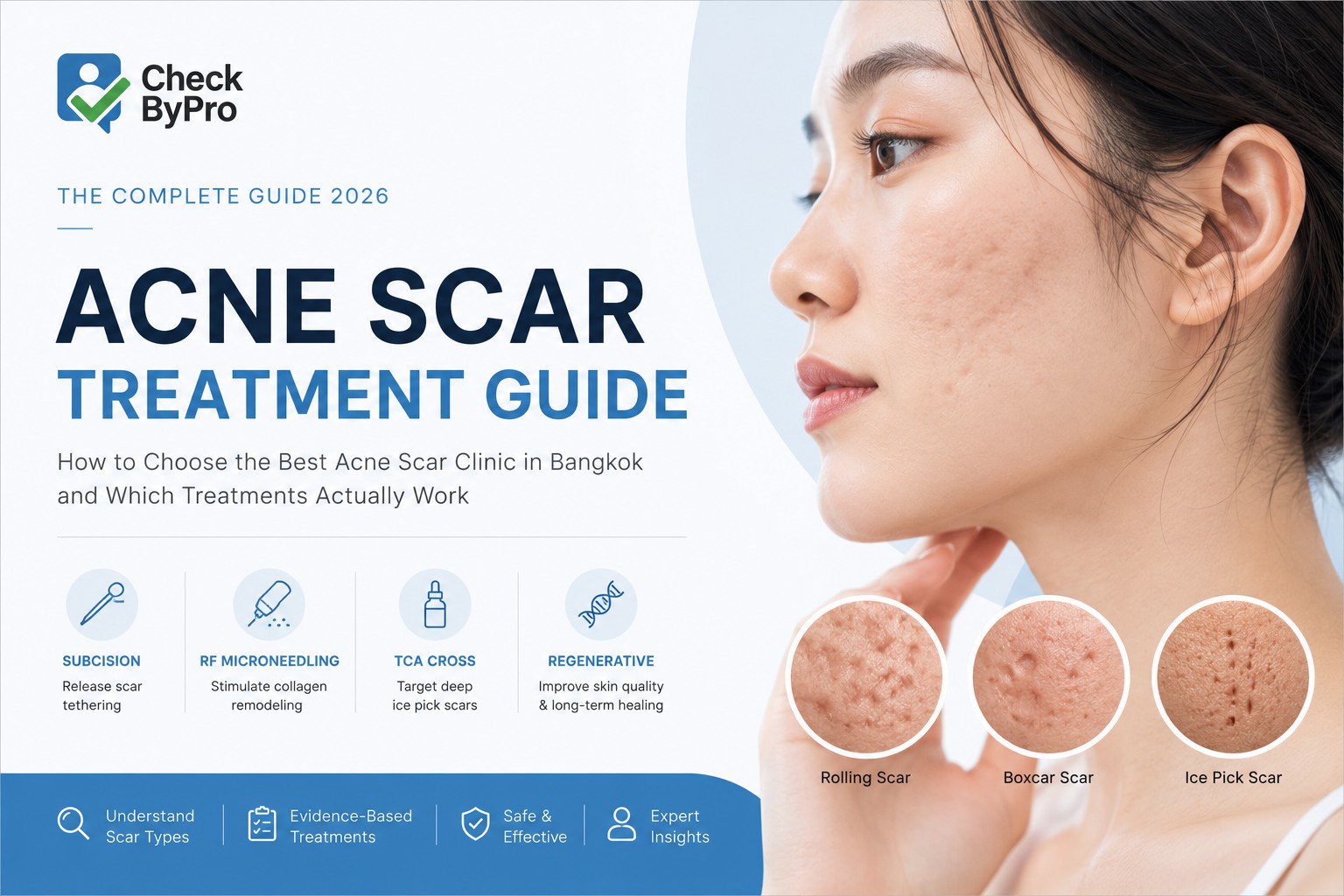
Best Acne Scar Clinic Bangkok 2026
A Complete Guide to Subcision, RF Microneedling, TCA CROSS and Modern Acne Scar Treatments
Introduction
Acne is frustrating.
Acne scars can be even worse.
Many people believe that once their acne disappears, their skin will eventually return to normal.
Unfortunately, that is often not what happens.
Months after the acne is gone, the scars remain.
Years later, the scars may still be visible.
Some people spend thousands of dollars on skincare.
Others undergo multiple laser sessions.
Many try chemical peels, microneedling, collagen supplements, expensive serums, and even social media skincare trends.
Yet despite all these efforts, the scars often remain surprisingly unchanged.
This experience is extremely common.
One reason is that acne scars are frequently misunderstood.
Most people think acne scars are a surface problem.
In reality, many acne scars are structural problems beneath the skin.
This distinction changes everything.
Understanding this concept is one of the most important steps toward finding effective treatment.
Why Acne Scars Are Different from Pigmentation
Many skin concerns affect color.
Acne scars affect structure.
Pigmentation problems occur when melanin becomes unevenly distributed.
The skin surface itself remains relatively intact.
Acne scars are different.
The underlying architecture of the skin has been damaged.
When inflammation destroys collagen, the skin loses support.
The result is a depression.
A shadow.
An uneven surface.
This is why many whitening products, brightening serums, and pigment-targeting lasers often fail to significantly improve acne scars.
The problem is not skin color.
The problem is missing structure.
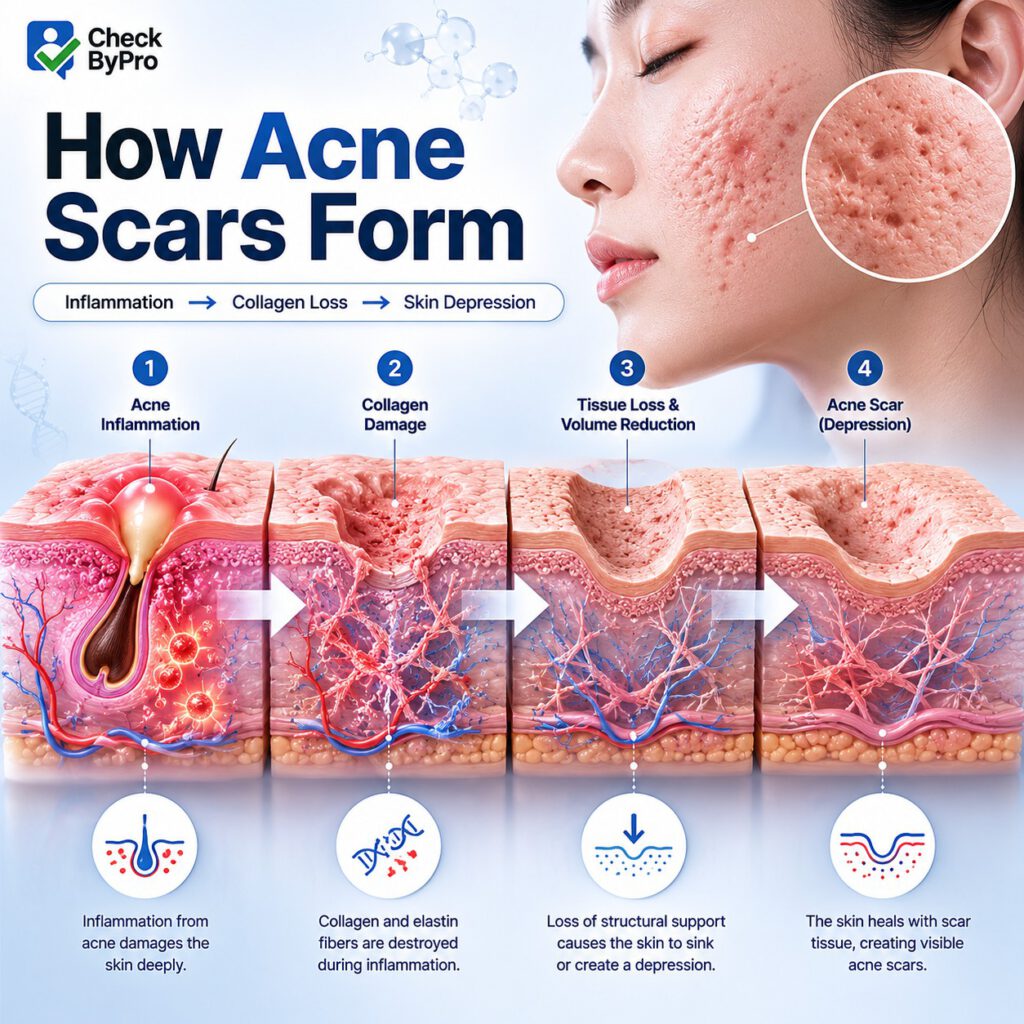
Understanding How Acne Scars Form
Healthy skin contains a complex network of collagen fibers.
These fibers provide support and maintain a smooth appearance.
When severe acne develops, inflammation damages these structures.
The body attempts to repair the injury.
Unfortunately, healing is not always perfect.
Several things can happen:
- Collagen may be destroyed
- Scar tissue may form
- Fibrous bands may develop
- Tissue volume may be lost
The result becomes visible as acne scarring.
Some scars are shallow.
Some scars are deep.
Some scars are tethered beneath the skin.
Each type behaves differently.
This is why accurate diagnosis is essential.
The Three Major Types of Acne Scars
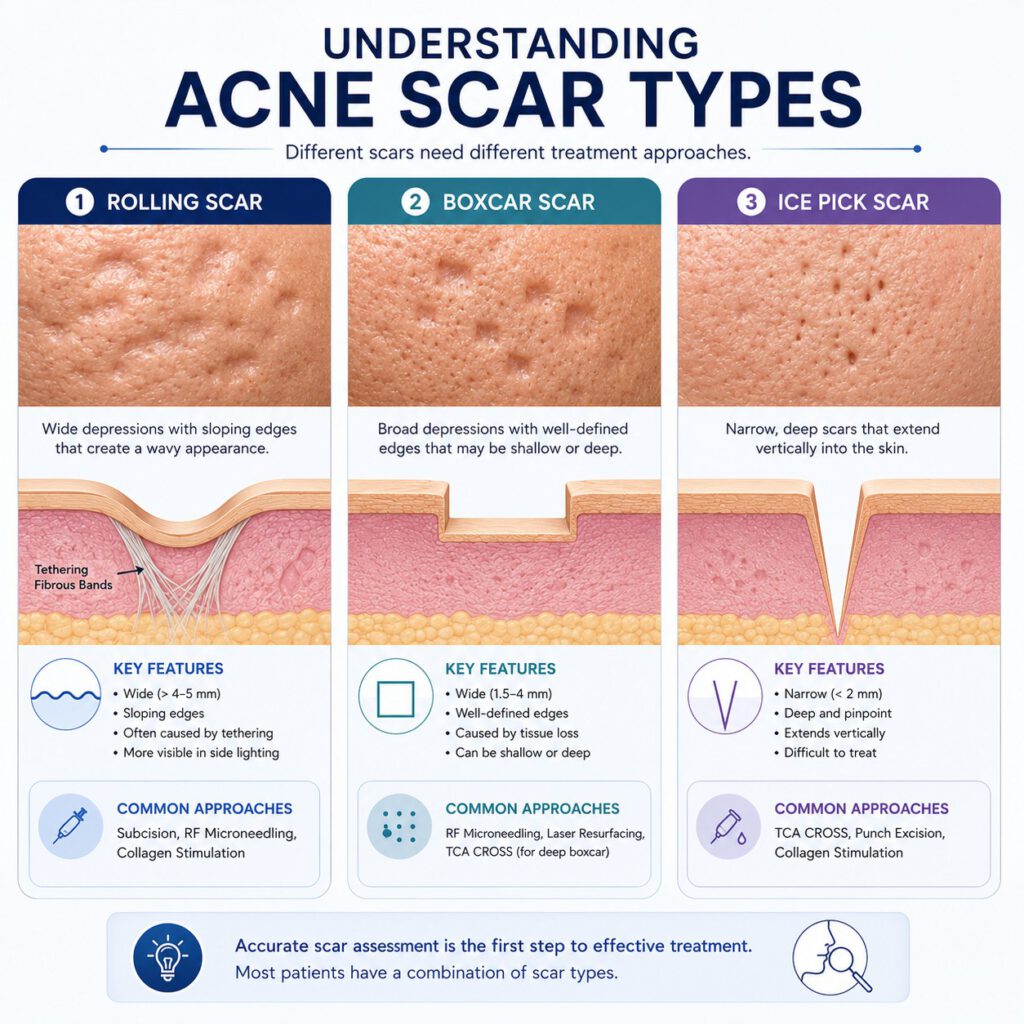
Before choosing any treatment, patients should understand which scar type they have.
Rolling Scars
Rolling scars are broad depressions that create a wave-like appearance.
They often become more visible under directional lighting.
Many rolling scars are tethered beneath the skin by fibrous bands.
This explains why treatments such as Subcision Bangkok have become increasingly important for patients with this scar pattern.
Boxcar Scars
Boxcar scars are wider depressions with defined edges.
These scars may be shallow or deep.
Unlike rolling scars, they are often caused primarily by collagen loss.
Treatment typically focuses on collagen remodeling and structural improvement.
Ice Pick Scars
Ice pick scars are narrow but extremely deep.
They often resemble enlarged pores.
Because of their depth, these scars can be particularly challenging to treat.
Many specialists utilize TCA CROSS Bangkok procedures to target these deep scars directly.
Why Many Acne Scar Treatments Fail
Perhaps the biggest reason patients become disappointed is because treatment selection does not match scar type.
Imagine treating a broken bone with skin cream.
No matter how expensive the cream is, it cannot repair the bone.
The same principle applies to acne scars.
A treatment designed for pigmentation may not significantly improve tethered scars.
A treatment designed for texture may not adequately address deep ice pick scars.
A treatment designed for collagen stimulation may not release scar attachments.
This mismatch is one of the most common causes of unsatisfactory outcomes.
The Evolution of Modern Acne Scar Treatment
Ten years ago, many clinics relied heavily on laser resurfacing.
Today, the field has evolved significantly.
Modern specialists increasingly focus on structural correction.
Instead of asking:
“What laser should we use?”
They ask:
“What is causing this scar?”
That question leads to better treatment planning.
For patients researching advanced Acne Scar Treatment Bangkok options, this distinction is extremely important.
Modern scar revision is no longer about finding one miracle treatment.
It is about combining procedures strategically.
Why Combination Therapy Is Becoming the Gold Standard
Acne scars involve multiple biological problems.
These may include:
- Scar tethering
- Collagen loss
- Surface irregularity
- Poor tissue quality
- Volume deficiency
Because of this complexity, a single treatment often produces limited improvement.
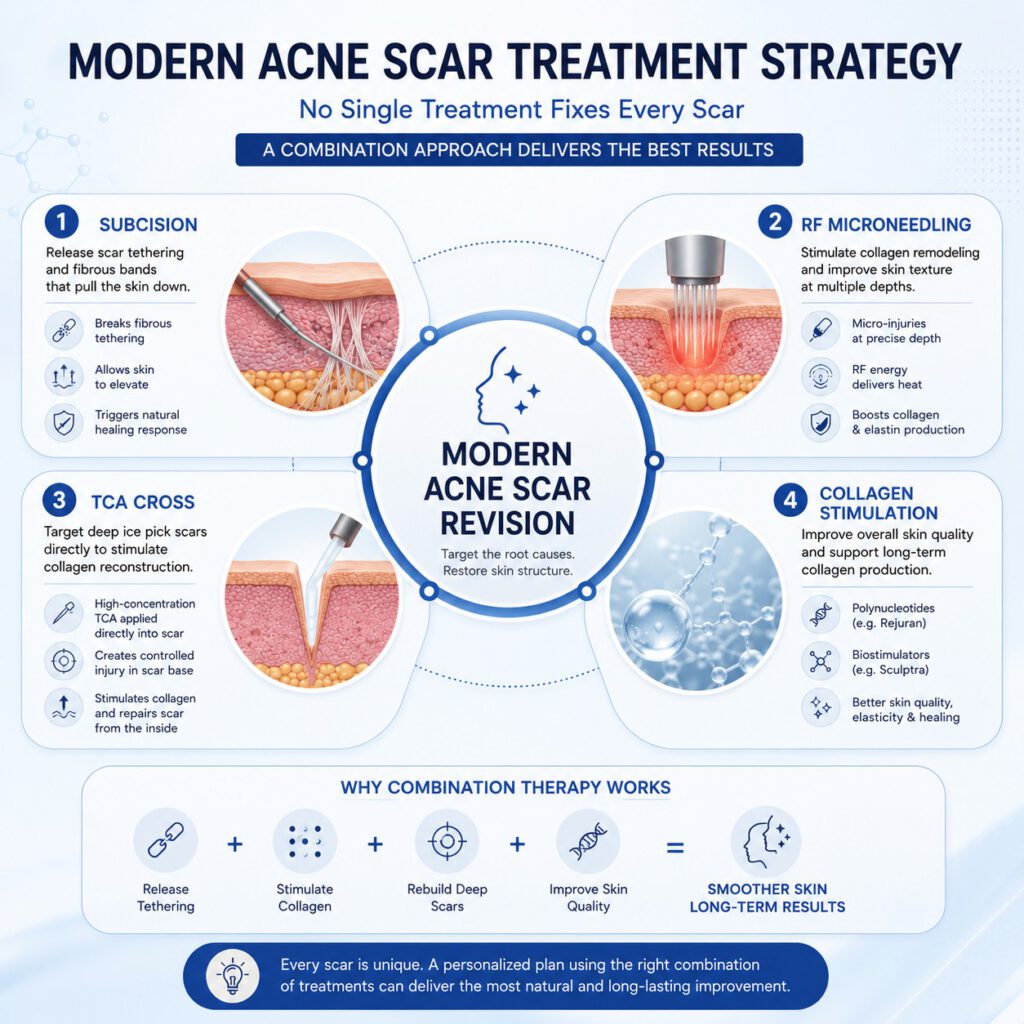
Modern acne scar specialists increasingly combine:
- Subcision
- RF Microneedling
- TCA CROSS
- Polynucleotides
- Biostimulators
Each treatment addresses a different aspect of scar formation.
Together, they can often produce superior results.
Why Bangkok Has Become a Destination for Acne Scar Treatment
Over the last decade, Bangkok has become one of Asia’s leading destinations for aesthetic medicine.
Patients travel from:
- Australia
- Singapore
- United Kingdom
- United States
- Canada
- Europe
to seek advanced acne scar treatment.
Many international patients researching the Best Acne Scar Clinic Bangkok compare clinics based on:
- Treatment philosophy
- Available technologies
- Combination therapy expertise
- Experience with complex scars
Increasingly, patients are looking beyond marketing claims and focusing on clinics that understand structural scar revision.
The Science Behind Acne Scar Revision: Why Subcision and RF Microneedling Have Changed Modern Acne Scar Treatment
Why Understanding Scar Structure Matters
One of the biggest breakthroughs in acne scar treatment came when physicians realized something important:
Not all scars are simply “missing collagen.”
Many scars are physically attached to deeper tissue.
This discovery changed the way specialists approach acne scar revision.
Previously, many treatments focused primarily on resurfacing the skin.
The assumption was simple:
If new collagen could be generated near the surface, scars would improve.
While this works in some situations, many patients continued to see disappointing results.
The reason eventually became clear.
The skin surface was not always the primary problem.
The deeper structures beneath the skin were often responsible.
This realization led to the development of more advanced treatment strategies that focus on scar architecture rather than just skin texture.
What Is Scar Tethering?
Scar tethering occurs when fibrous bands form beneath the skin following inflammation.
During acne healing, the body attempts to repair damaged tissue.
Unfortunately, the repair process is not always smooth.
Instead of recreating healthy collagen architecture, dense scar tissue may form.
These fibrotic bands connect the skin surface to deeper tissue layers.
Over time, they pull the skin downward.
This pulling effect creates visible depressions.
Patients often notice:
- Shadows under certain lighting
- Scars appearing deeper when smiling
- Uneven skin texture
- Depressions that remain despite previous treatments
In many cases, the problem is not simply collagen loss.
The problem is mechanical tethering.
This distinction is critical because it changes which treatments are likely to be effective.
Why Rolling Scars Behave Differently
Among all acne scar types, rolling scars are the most commonly associated with tethering.
These scars typically appear as:
- Wide depressions
- Wave-like contours
- Soft edges
- Uneven reflections under light
Because rolling scars frequently involve fibrous attachments beneath the skin, simply stimulating collagen on the surface may not fully correct them.
Imagine trying to raise a tent while ropes continue pulling it downward.
No matter how much material is added to the tent, the ropes continue creating tension.
The same concept applies to tethered acne scars.
Before collagen remodeling can reach its full potential, the tethering often needs to be addressed.
This is one reason why many specialists consider Subcision Bangkok procedures one of the most important treatments for rolling scars.
What Is Subcision?
Subcision is a minimally invasive procedure designed to release scar tethering beneath the skin.
Rather than treating the surface, subcision targets the structural attachments responsible for scar depression.
The procedure involves inserting a specialized instrument beneath the skin.
The physician carefully releases fibrotic bands that pull the scar downward.
Once released:
- Mechanical tension decreases
- Skin elevation becomes possible
- Wound healing begins
- New collagen formation is stimulated
Unlike many aesthetic treatments, subcision addresses one of the actual causes of acne scarring rather than simply masking its appearance.
Why Subcision Is Often Called a Foundation Treatment
Many acne scar specialists view subcision as a foundational procedure because it directly targets scar architecture.
Patients who have undergone multiple resurfacing procedures sometimes experience significant improvement after tethering is finally addressed.
This does not mean subcision is a miracle treatment.
Rather, it means that certain scars require structural correction before other treatments can perform optimally.
When scar attachments are released, the skin gains greater freedom to remodel naturally.
For this reason, many modern acne scar treatment plans begin with subcision before introducing additional collagen-stimulating procedures.
Patients researching advanced Acne Scar Treatment Bangkok programs frequently encounter treatment plans built around this principle.
What Happens After Subcision?
One reason subcision remains valuable is that its effects continue long after the procedure itself.
Following treatment, the body initiates a healing response.
Fibroblasts become activated.
Growth factors are released.
Collagen production begins.
Over the following weeks and months, tissue remodeling gradually occurs.
This process explains why acne scar improvement often continues developing long after visible bruising or swelling has resolved.
Patients should understand that collagen remodeling is not instantaneous.
The body requires time to rebuild damaged structures.
RF Microneedling: The Next Stage of Scar Remodeling
While subcision addresses tethering, it does not fully solve collagen deficiency.
This is where RF Microneedling becomes important.
RF Microneedling is widely considered one of the most significant innovations in acne scar treatment over the past decade.
Rather than focusing exclusively on the skin surface, RF Microneedling delivers controlled energy into deeper tissue layers.
This stimulates collagen production where it is most needed.
How RF Microneedling Works
RF Microneedling combines two treatment mechanisms:
Mechanical Stimulation
Microneedles create controlled micro-injuries within the skin.
Radiofrequency Energy
Thermal energy is delivered directly into the dermis.
Together, these effects stimulate wound healing and collagen remodeling.
The goal is not to damage the skin.
The goal is to trigger controlled regeneration.
This regeneration encourages the body to produce new collagen and reorganize existing scar tissue.
Why RF Microneedling Is Different from Traditional Microneedling
Traditional microneedling primarily relies on needle injury.
RF Microneedling adds energy.
This additional thermal stimulation significantly increases collagen remodeling potential.
Benefits may include:
- Improved skin texture
- Scar softening
- Increased collagen production
- Better skin firmness
- Improved scar blending
Because acne scars often extend deeply into the dermis, deeper collagen stimulation is particularly valuable.
Infini RF Microneedling and Deep Scar Remodeling
Among RF Microneedling technologies, Infini has gained attention because of its ability to target multiple tissue depths.
This is important because acne scars rarely exist at a single level.
Some scars involve:
- Superficial dermis
- Mid dermis
- Deep dermis
- Subdermal structures
The ability to stimulate collagen at multiple depths may contribute to more comprehensive remodeling.
For this reason, many specialists combine Infini with subcision when treating moderate to severe acne scars.
The combination addresses:
Subcision
Scar tethering.
RF Microneedling
Collagen deficiency.
Together, these treatments target two major contributors to acne scar formation.
Why Combination Therapy Produces Better Results
Patients often ask:
“Should I choose subcision or RF Microneedling?”
The question itself may be misleading.
Modern acne scar revision increasingly recognizes that different procedures solve different problems.
For example:
| Problem | Treatment |
|---|---|
| Scar Tethering | Subcision |
| Collagen Loss | RF Microneedling |
| Deep Ice Pick Scars | TCA CROSS |
| Skin Quality | Polynucleotides |
| Long-Term Collagen Stimulation | Biostimulators |
Instead of searching for one perfect treatment, specialists increasingly combine treatments strategically.
This philosophy has become a defining feature of modern acne scar revision.
Patients researching the Best Acne Scar Clinic Bangkok often discover that leading acne scar clinics emphasize customized treatment plans rather than promoting a single technology.
Why Results Take Time
One of the biggest misconceptions in acne scar treatment is the expectation of immediate transformation.
Unfortunately, collagen does not rebuild overnight.
After treatment, the body enters a healing phase.
During this period:
- Fibroblasts become active
- New collagen forms
- Scar tissue reorganizes
- Tissue quality improves
This process often continues for months.
The final result is therefore usually gradual rather than immediate.
Patients who understand this process tend to have more realistic expectations and greater satisfaction with treatment outcomes.
TCA CROSS, Polynucleotides, Biostimulators and Why Some Acne Scars Are More Difficult to Treat Than Others
Why Ice Pick Scars Are Different from Other Acne Scars
Not all acne scars behave the same way.
This is one of the biggest reasons why many patients become frustrated during treatment.
Some scars improve relatively quickly.
Others seem resistant despite multiple procedures.
Among all acne scar types, ice pick scars are often considered the most challenging.
These scars appear as:
- Narrow depressions
- Deep vertical channels
- Small but noticeable pits
- Enlarged pore-like defects
Unlike rolling scars, which frequently involve tethering, ice pick scars extend deeply into the skin.
Because of their shape, many traditional resurfacing treatments struggle to adequately reach the bottom of the scar.
As a result, specialized treatment approaches are often required.
What Is TCA CROSS?
One of the most widely recognized treatments for deep narrow scars is TCA CROSS.
Patients researching TCA CROSS Bangkok often encounter this procedure when searching for treatment options for ice pick scars.
TCA CROSS stands for:
Chemical Reconstruction Of Skin Scars
Unlike traditional chemical peels that treat larger skin areas, TCA CROSS focuses directly on individual scars.
The procedure involves placing a highly concentrated TCA solution into the scar itself.
This creates a controlled injury that stimulates wound healing and collagen production within the scar.
The goal is gradual reconstruction of the scar from the inside.
Why TCA CROSS Can Be Effective for Deep Scars
One reason TCA CROSS remains popular is because it can reach depths that many surface treatments cannot.
When performed appropriately, the treatment stimulates:
- Collagen formation
- Tissue remodeling
- Scar contraction
- Gradual elevation of depressed scars
Because the treatment targets individual scars directly, it is particularly useful for:
- Ice pick scars
- Deep boxcar scars
- Narrow atrophic scars
However, patients should understand that meaningful improvement often requires multiple treatment sessions.
Scar remodeling is a gradual biological process.
Why TCA CROSS Alone Is Not Always Enough
Although TCA CROSS can be highly effective for specific scar types, it does not solve every acne scar problem.
For example:
Rolling Scars
Often require tethering release.
Broad Boxcar Scars
May require collagen remodeling.
Poor Skin Quality
May benefit from regenerative therapies.
This is why modern acne scar specialists increasingly use combination therapy rather than relying on a single procedure.
Patients seeking advanced Acne Scar Treatment Bangkok options frequently receive treatment plans incorporating multiple complementary procedures.
The Rise of Regenerative Acne Scar Treatments
Over the past decade, regenerative medicine has become one of the most exciting developments in aesthetic medicine.
Rather than simply removing tissue or resurfacing skin, regenerative treatments aim to improve the skin’s ability to repair itself.
This shift has influenced many areas of acne scar revision.
Today, specialists increasingly explore methods that support:
- Tissue regeneration
- Collagen production
- Cellular repair
- Improved skin quality
Among the most discussed regenerative approaches are polynucleotide treatments.
What Are Polynucleotides?
Polynucleotides are DNA-derived molecules designed to support tissue repair and regeneration.
Unlike fillers, which primarily provide volume, polynucleotides aim to improve the biological environment of the skin.
Many specialists incorporate these treatments into comprehensive acne scar treatment plans because healthy tissue often responds better to remodeling procedures.
Potential benefits may include:
- Improved hydration
- Enhanced healing
- Better skin quality
- Improved elasticity
- Support for collagen production
Understanding Rejuran and Polynucleotide Therapy
One of the most recognized polynucleotide treatments is Rejuran.
Rather than functioning as a traditional filler, Rejuran focuses on tissue regeneration.
The treatment has become increasingly popular throughout Asia for patients seeking skin quality improvement.
While Rejuran does not directly release tethered scars or replace lost volume, it may complement other acne scar procedures.
For example:
- Subcision addresses scar attachments.
- RF Microneedling stimulates collagen.
- Rejuran supports tissue quality.
This illustrates how different procedures can work together within a comprehensive treatment plan.
Biostimulators and Long-Term Collagen Production
Another category receiving significant attention is biostimulatory treatment.
Unlike conventional fillers that primarily add volume, biostimulators encourage the body to generate its own collagen over time.
This distinction is important.
The goal is not simply filling a depression.
The goal is improving the structural foundation of the skin.
Because collagen plays such an important role in acne scar formation, treatments that stimulate collagen production may contribute to long-term scar improvement.
Why Collagen Matters So Much in Acne Scar Revision
Collagen is the primary structural protein responsible for skin support.
When severe acne destroys collagen, the skin loses volume and strength.
The resulting depression becomes visible as a scar.
Successful acne scar treatment therefore often focuses on rebuilding collagen.
Different procedures stimulate collagen through different mechanisms.
Examples include:
Subcision
Triggers wound healing and collagen formation after scar release.
RF Microneedling
Uses controlled thermal stimulation to encourage collagen remodeling.
TCA CROSS
Promotes collagen production within deep scars.
Biostimulators
Encourage long-term collagen synthesis.
This is why many modern acne scar specialists view collagen remodeling as one of the central goals of treatment.
Why Acne Scar Improvement Is Usually Gradual
Many patients hope to see dramatic changes immediately after treatment.
Unfortunately, biology rarely works that way.
Collagen remodeling takes time.
Following treatment, the body undergoes several stages:
Inflammation
The healing response begins.
Proliferation
Fibroblasts produce new collagen.
Remodeling
Collagen fibers reorganize and strengthen.
This process can continue for several months.
As a result, improvement often develops gradually rather than overnight.
Patients who understand this concept generally have more realistic expectations and better treatment experiences.
How Many Treatments Are Usually Needed?
There is no universal answer.
The number of treatments depends on:
- Scar type
- Scar severity
- Skin quality
- Individual healing response
- Treatment goals
Mild scars may require relatively few sessions.
More severe scars often benefit from staged treatment plans over several months.
Because acne scars represent permanent structural damage, meaningful improvement typically requires patience and consistency.
Common Mistakes Patients Make During Acne Scar Treatment
Expecting One Treatment to Solve Everything
Acne scars are complex.
Different scars often require different solutions.
Chasing Every New Technology
New technology is not automatically superior.
Proper diagnosis remains more important than equipment alone.
Comparing Results Too Early
Collagen remodeling requires time.
Judging results prematurely may create unnecessary disappointment.
Ignoring Scar Type
Understanding whether scars are rolling, boxcar, or ice pick remains one of the most important factors in treatment planning.
Why Treatment Planning Matters More Than Technology
Many clinics advertise devices.
Experienced specialists focus on diagnosis.
The best outcomes usually occur when treatment selection is based on:
- Scar morphology
- Tissue characteristics
- Healing biology
- Structural abnormalities
This individualized approach has become a hallmark of modern acne scar revision.
Patients researching the Best Acne Scar Clinic Bangkok often discover that the most experienced clinics focus heavily on treatment planning rather than simply promoting technology.
How to Choose the Best Acne Scar Clinic Bangkok, Recovery Expectations, FAQs and Final Recommendations
Choosing the Right Acne Scar Clinic Matters More Than Most Patients Realize
Many people spend months researching acne scar treatments.
They compare lasers.
They compare prices.
They compare before-and-after photos.
However, one factor is often overlooked:
Choosing the right clinic.
This decision may have a greater impact on treatment outcomes than any individual device.
Why?
Because acne scar treatment is rarely about a single procedure.
Successful treatment depends on:
- Accurate diagnosis
- Proper scar classification
- Treatment planning
- Procedure sequencing
- Realistic expectations
- Follow-up care
A clinic that understands these principles can often achieve better outcomes than a clinic that simply owns expensive equipment.
This is one reason patients searching for the Best Acne Scar Clinic Bangkok increasingly focus on expertise and treatment philosophy rather than marketing claims alone.
Questions Patients Should Ask Before Starting Acne Scar Treatment
Before committing to any treatment plan, patients should ask several important questions.
What Type of Acne Scars Do I Have?
This should be the first question.
Many patients have a mixture of:
- Rolling scars
- Boxcar scars
- Ice pick scars
Each scar type may require a different approach.
A treatment that works well for rolling scars may provide limited improvement for ice pick scars.
Why Is This Treatment Being Recommended?
Patients should understand the rationale behind every procedure.
For example:
If a clinic recommends Subcision Bangkok treatment, the explanation should include scar tethering and rolling scar correction.
If a clinic recommends TCA CROSS Bangkok treatment, the explanation should involve deep narrow scars such as ice pick scars.
Understanding the reasoning behind treatment recommendations helps patients make informed decisions.
What Level of Improvement Is Realistic?
This question is extremely important.
Ethical providers should discuss realistic expectations.
No treatment can guarantee perfect skin.
No treatment can promise complete scar removal.
However, meaningful improvement is often achievable.
Patients should be wary of exaggerated promises and unrealistic marketing claims.
What Recovery Is Typically Like
Recovery depends on the procedures performed.
Different treatments affect the skin differently.
Understanding downtime helps patients plan appropriately.
Recovery After Subcision
Following subcision, patients may experience:
- Mild swelling
- Bruising
- Tenderness
- Temporary fullness
These effects are usually temporary.
The healing process continues long after visible recovery has occurred.
Collagen remodeling may continue for months.
Recovery After RF Microneedling
Most patients experience:
- Redness
- Mild swelling
- Temporary sensitivity
The degree of downtime varies depending on treatment intensity.
Many patients return to normal activities relatively quickly.
Recovery After TCA CROSS
Patients commonly experience:
- Small crusts
- Localized redness
- Temporary discoloration
Proper aftercare is important during the healing process.
Because TCA CROSS intentionally creates a controlled wound, patience is required while the skin repairs itself.
Why Some Patients Improve Faster Than Others
One question specialists hear frequently is:
“Why did someone else improve faster than I did?”
The answer usually involves biology.
Every patient heals differently.
Several factors influence outcomes:
Age
Collagen production generally slows with age.
Scar Severity
Severe scars often require more treatment.
Skin Thickness
Different skin types respond differently.
Genetics
Healing responses vary among individuals.
Lifestyle Factors
Smoking, nutrition, stress, and sun exposure can all influence healing.
Because of these variables, treatment timelines should always be viewed as estimates rather than guarantees.
Why International Patients Travel to Bangkok for Acne Scar Treatment
Bangkok has become one of the most recognized destinations for aesthetic medicine in Asia.
Patients travel from:
- Australia
- New Zealand
- Singapore
- United Kingdom
- Canada
- United States
- Europe
for a wide range of cosmetic procedures.
Several factors contribute to Bangkok’s popularity.
Advanced Treatment Options
Modern clinics increasingly offer combination treatment strategies that address multiple aspects of acne scarring.
Experienced Practitioners
Many providers focus heavily on acne scar revision and have experience managing complex scar patterns.
Cost Efficiency
Treatment costs may be significantly lower than in some Western countries while still offering access to advanced technologies.
Comprehensive Treatment Planning
Patients often appreciate the ability to access multiple treatment modalities within a single treatment center.
For individuals researching Acne Scar Treatment Bangkok options, this combination of factors can be particularly attractive.
Frequently Asked Questions
Can Acne Scars Be Permanently Removed?
Acne scars represent permanent structural changes within the skin.
Complete removal cannot be guaranteed.
However, many patients achieve significant improvement through appropriate treatment.
The goal is improvement rather than perfection.
Are Acne Scar Results Permanent?
New collagen created during treatment can provide long-term improvement.
However, natural aging continues throughout life.
Skin gradually loses collagen over time.
Many patients maintain their improvements for years.
Is Laser Better Than Subcision?
Neither treatment is universally better.
They address different problems.
Subcision focuses on tethering.
Laser and RF technologies often focus on collagen remodeling and skin quality.
This is why combination therapy is increasingly popular.
Is One Treatment Session Enough?
For most patients, no.
Acne scars develop over years.
Meaningful improvement usually requires multiple treatment sessions.
Patience is an important part of the process.
Which Acne Scar Type Is Most Difficult to Treat?
Many specialists consider deep ice pick scars among the most challenging.
However, severe rolling scars with extensive tethering can also be difficult.
Treatment complexity depends on the individual patient rather than scar type alone.
Why Modern Acne Scar Revision Focuses on Combination Therapy
One of the most important developments in acne scar treatment has been the shift away from single-treatment thinking.
Historically, patients often searched for:
- The best laser
- The newest device
- The fastest treatment
Today, specialists increasingly focus on understanding scar biology.
Different procedures solve different problems.
For example:
| Problem | Common Treatment |
|---|---|
| Scar Tethering | Subcision |
| Deep Ice Pick Scars | TCA CROSS |
| Collagen Loss | RF Microneedling |
| Tissue Quality | Polynucleotides |
| Long-Term Collagen Stimulation | Biostimulators |
This combination approach reflects a deeper understanding of how acne scars develop.
Final Verdict: How to Choose the Best Acne Scar Clinic Bangkok
If there is one lesson patients should remember, it is this:
Acne scar treatment is not about finding the most expensive machine.
It is not about finding the newest technology.
It is not about finding the fastest treatment.
Successful acne scar revision begins with understanding the scars themselves.
The most effective clinics typically focus on:
- Accurate diagnosis
- Individualized treatment planning
- Scar-specific procedures
- Realistic expectations
- Long-term collagen remodeling
Patients researching the Best Acne Scar Clinic Bangkok should prioritize expertise, treatment philosophy, and comprehensive scar assessment over marketing promises.
Modern acne scar treatment has advanced tremendously over the past decade.
Today, procedures such as:
- Subcision Bangkok
- TCA CROSS Bangkok
- Acne Scar Treatment Bangkok programs incorporating RF Microneedling and collagen stimulation
have made meaningful improvements possible for many patients who previously had limited options.
While perfection may not be achievable, significant improvement often is.
With proper diagnosis, realistic expectations, and a carefully planned treatment strategy, many patients can achieve smoother skin, reduced scar visibility, and greater confidence.
You can contact Bangkok Aesthetics Clinic (BAC Clinic) through the following channels:
- Map and Directions: https://maps.app.goo.gl/kKE6w4nj5xS1ZHaX7
- BAC Clinic
180 Sixteenrh Place 1st floor, Sukhumvit soi 16,
Khlong Toei, Bangkok 10110, Thailand - (+66) 2 0033365
- baclasercenter@gmail.com
Opening Hours
Tuesday — Friday: 11:00 AM — 8:00 PM
Saturday-Sunday: 11:00 AM — 7:00 PM
Monday: Closed
- Line : https://bit.ly/3a4Sq1H
- Line : @bacclinic
- Instagram : BAC_CLINIC
- Facebook BAC Clinic or click bangkokaestheticsclinic
- Getting there:
- The clinic is located in Sukhumvit Soi 16, near Asok. You can take the BTS to Asok Station or the MRT to Queen Sirikit National Convention Centre/Asok area and continue into Sukhumvit 16.
- If you’re traveling to Bangkok specifically for acne scar treatment, you can contact the clinic in advance via LINE or email through their website to arrange a consultation and treatment plan.